Used-Car Prices Are High: How to Buy or Sell Privately
By Andy, Founder, TitlePull
Last updated June 3, 2026 · Reviewed by Andy · June 2026
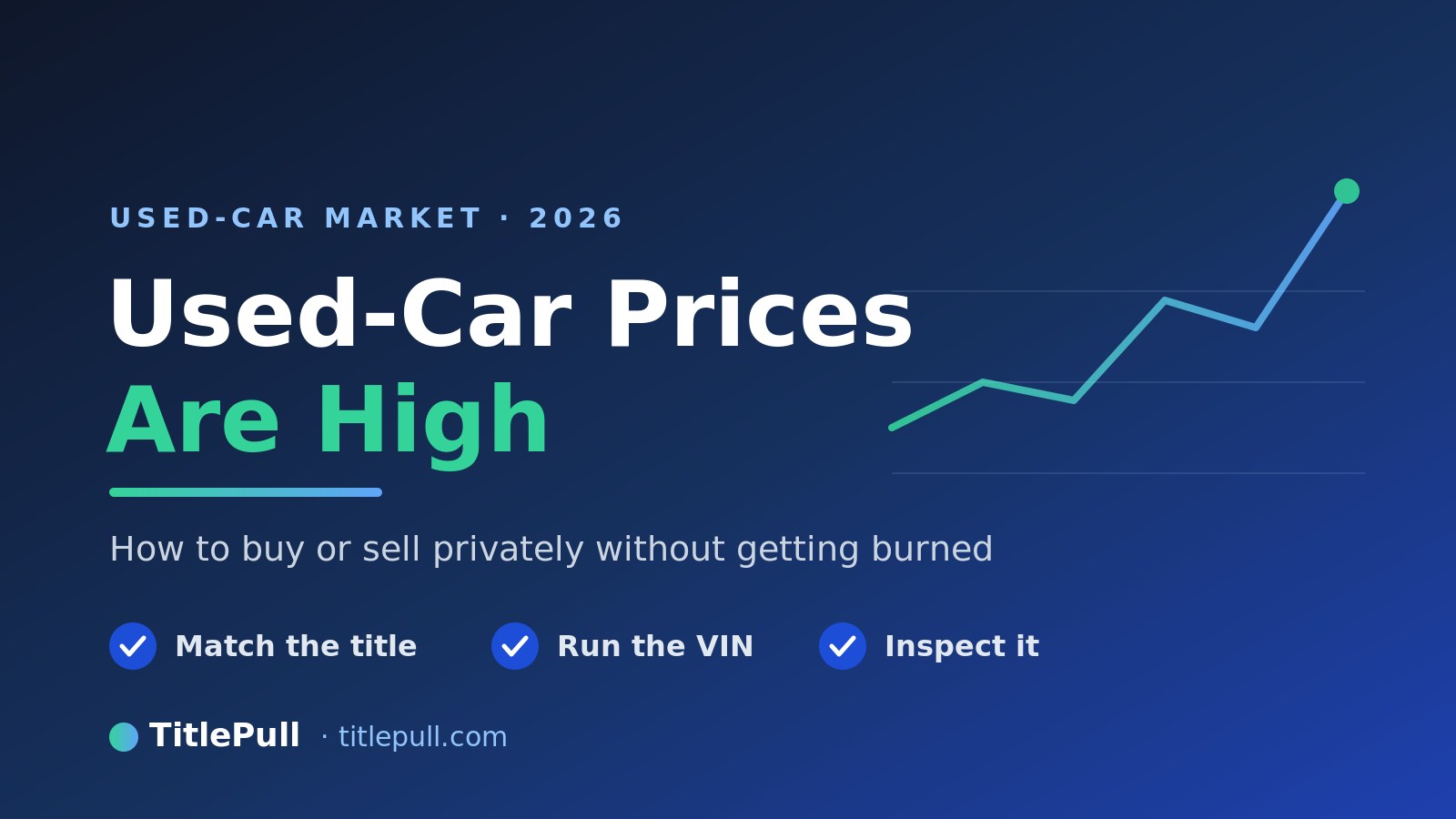
Used cars are more expensive in 2026 than they've been in nearly three years. Used-vehicle values climbed to their highest point since 2023 this spring, running about 6% above a year earlier, as strong demand met a tight supply of late-model cars (Cox Automotive's Manheim index). More of that activity is happening directly between private buyers and sellers rather than through a dealership.
A private sale can be a great deal on both sides. It also moves more of the responsibility onto you. This guide walks through how to protect yourself whether you're the one buying or the one selling.
Why this market raises the stakes
When prices are elevated, every part of a transaction carries more weight. Paying a few thousand over fair value hurts more. A hidden problem you discover after the sale costs more to fix relative to what you already spent. And because demand is high, good cars move fast, which can pressure buyers into rushing a decision they'd normally take slowly.
None of that means you should sit out the market. It means the basic checks matter more than usual, and they're worth the extra hour they take.
If you're buying from a private seller
Confirm the title before anything else
The single most important check in a private sale is simple: does the name on the title match the ID of the person selling you the car? If it doesn't, stop and ask why. A seller who is "helping a friend" or selling "a family member's car" may be perfectly honest, or may be moving a car they don't have the right to sell. Either way, you need a clear paper trail to register the vehicle later.
Run the VIN history before you fall in love with the car
A clean-looking car and a clean-sounding story aren't the same as a clean record. Before you commit, decode the VIN, we have make-specific decoders for popular shopping targets like Toyota, Honda, Ford F-150, Tesla, and Subaru, and run it through a history report. A good report surfaces the things a quick test drive can't: official title-brand records like salvage or flood, total-loss history, odometer readings over time that reveal rollback, and any open safety recalls that still need to be fixed.
With TitlePull, that check is a flat $9.99 per VIN, instant, and requires no account, and you get a plain-English summary instead of a wall of codes. Running it early, before you've driven two hours to see the car, saves you from wasting a trip on a vehicle the records already rule out.
Get an independent inspection
A history report tells you about the car's recorded past. A mechanic tells you about its present condition. The two together are the closest you'll get to a complete picture. A seller who welcomes an independent inspection is showing you confidence; one who refuses is showing you something too.
Don't let scarcity rush you
High demand is real, and yes, good cars sell quickly. But "you need to decide today" is also the oldest pressure tactic in the book. A seller who won't hold a car for a same-day inspection is telling you how the rest of the transaction would go. (For more warning signs, see our used-car buying guide.)
If you're selling your car privately
This market favors sellers, which makes it a good time to sell directly rather than trade in. A little preparation helps you get a fair price quickly and avoid the back-and-forth that drags sales out.
Have your paperwork straight
Locate your title and confirm the name on it matches your ID. Gather maintenance records, receipts for recent work, and the second key if you have it. Buyers pay more, and faster, for a car that comes with a clean, organized history.
Price it with real numbers
Look up your car's fair market value using current guides rather than guessing or anchoring to what you paid. An honestly priced car attracts serious buyers; an overpriced one sits and invites lowball offers.
Show buyers the record up front
One of the most effective things a private seller can do is run a history report on their own VIN before listing. When you can hand a buyer an honest, plain-English record showing no hidden brands or odometer issues, you remove their biggest objection before they raise it. At $9.99, it's a small investment that can shorten your sale and justify your asking price.
Protect yourself at handoff
Use a written bill of sale, complete the title transfer properly for your state, and remove your plates and insurance once the deal is done. Clean closure protects you from liability for anything the new owner does later.
The through-line for both sides
Whether you're buying or selling, the same principle applies: the paperwork can change far more easily than the car's real history. In a market this expensive, the few minutes it takes to verify a VIN is the cheapest insurance you'll buy all year. New to the process? Start with our first-time buyer's guide.
Before your next private deal, on either side of it, run the VIN through a TitlePull report. Flat $9.99, instant, no account, and a summary you can actually read.
Sources
- Cox Automotive, Manheim Used Vehicle Value Index (used-vehicle values): https://www.coxautoinc.com/market-insights/manheim-used-vehicle-value-index/
- Federal Trade Commission, Buying a Used Car: https://consumer.ftc.gov/articles/buying-used-car-dealer
Frequently asked questions
Why are used-car prices so high in 2026?
Strong demand met tight supply. Tax-refund season pulled buyers into the market while the number of late-model used cars stayed limited, and used-vehicle values reached their highest point since 2023 this spring (Cox Automotive's Manheim index). The practical effect for you is that there's less room for error, paying too much for a car with a hidden problem stings more when prices are already elevated.
Is it safe to buy a car from a private seller?
It can be, and private sales often save you money versus a dealer. The trade-off is that private sales come with fewer built-in protections, so the responsibility to verify the car falls on you. Confirm the seller's name matches the title, run the VIN through a history report, and have the car inspected by an independent mechanic before money changes hands.
What should I check before selling my car privately?
Have your title in hand and make sure the name on it matches your ID, gather your maintenance records, and know your car's fair market value so you can price it confidently. Many sellers also run a history report on their own VIN before listing, it lets you show buyers an honest record up front, which builds trust and can speed up the sale.
Disclosures
TitlePull is not a consumer reporting agency under the Fair Credit Reporting Act. Reports are for informational purposes and may not be used for employment, tenant, credit, or insurance underwriting decisions.
Get the full vehicle history for $9.99.
Check a VIN