How to Check If a Car Title Is Clean
By Andy, Founder, TitlePull
Last updated July 6, 2026 · Reviewed by Andy · July 2026
How to check if a car title is clean
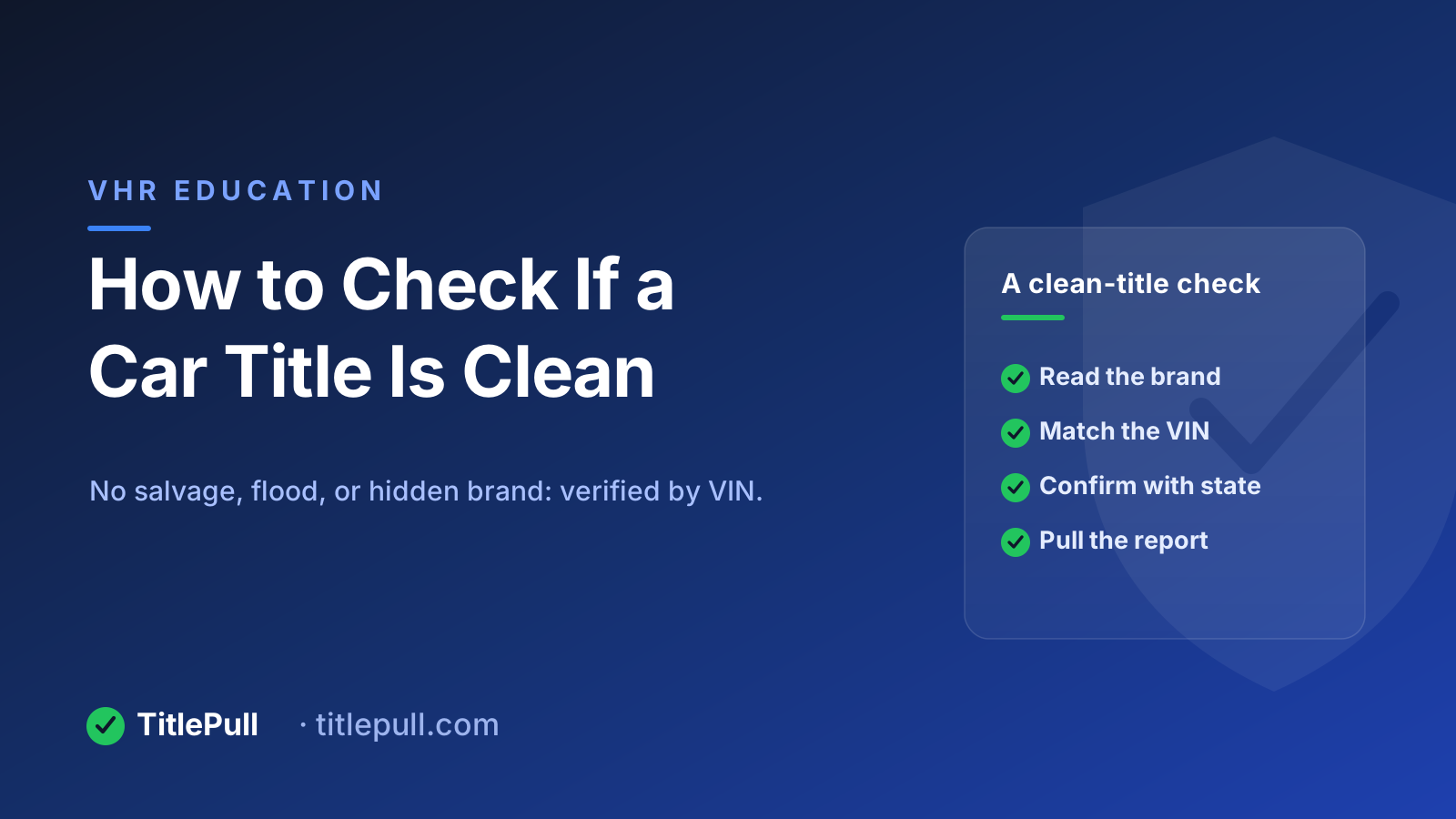
To check if a car title is clean, read the title for any brand, match the VIN across the car and the paperwork, confirm the title status by VIN with the state, and pull a full history report. A clean title is one with no brand such as salvage, rebuilt, flood, junk, lemon, or total loss on record. These steps take a few minutes and cost little or nothing, and they protect you from paying a clean-title price for a car that is anything but. Here is how to do each one.
What a clean title actually means
A clean title means no brand has been recorded against the vehicle, not that the car is perfect. States and insurers apply a brand when something significant happens to a car, such as a salvage brand when an insurer declares it a total loss, or a flood, junk, or lemon brand for other events. A title with none of these is considered clean.
The key thing to understand is that clean refers to the record, not the metal. A car can carry a clean title and still have hidden crash repair, a rolled-back odometer, or an open recall, because not every problem produces a brand. Damage repaired without an insurance claim, for example, may never be branded at all. So a clean title is the starting point of your due diligence, not the finish line. For the full menu of brands and what they mean, see salvage vs. rebuilt titles.
Step 1: Read the title and confirm the seller owns it
Start by reading the actual title document, because the brand, if any, is printed right on it. Look for any word other than a clean designation, such as salvage, rebuilt, reconstructed, flood, water damage, junk, lemon, or total loss. Then confirm the title is in the seller's name and that the name matches their photo identification. If the seller does not have the title, or it is in someone else's name, resolve that before anything else.
Many financed cars have an electronic title held by the state and the lender, so a seller with a current loan may not have a paper copy at all. That is normal, but it also means there may be a lien to clear before the title can pass to you cleanly. A seller who cannot explain the title situation is a reason to slow down.
Step 2: Match the VIN on the title, dash, and door jamb
Confirm the VIN on the title matches the car exactly, in every place the number appears. Check the 17-character VIN on the dash where it meets the windshield, on the sticker inside the driver's door jamb, and on the title and registration. Every one must be identical.
A VIN that does not match, or a plate that looks altered, can mean the title does not actually belong to this car, or that the vehicle identification number has been tampered with. Run the number through our free VIN decoder to confirm the year, make, and model on the paperwork match the car in front of you. This simple match is what stops a clean title from a different vehicle being passed off with the car you are looking at.
Step 3: Confirm the title status by VIN with the state
Verify the title status directly with the state, since the state is the system of record for brands. Many state motor vehicle agencies let you check a title or brand status by VIN online, by phone, or in person. State consumer resources, like the Texas DMV's Title Check page, encourage buyers to look up a vehicle's title before purchase for exactly this reason. Because procedures differ, check the state where the car is currently titled.
Confirming with the state matters because a brand is supposed to follow the car when it is retitled elsewhere, but the paper in the seller's hand only reflects the most recent state. Going to the source, plus the history report in the next step, is how you catch a brand that an out-of-state title might not show.
Step 4: Pull a full title and history report
Pull a vehicle history report by VIN so a brand from another state cannot hide behind a freshly issued title. This is the step that guards against title washing, where a branded car is retitled across state lines until the brand drops off the visible paperwork. A history report follows the VIN through every state the car has lived in, so it can surface a salvage or flood brand from years and states ago even when the current title looks clean.
A report also rounds out the parts a title never shows, flagging total-loss and salvage records, odometer history, and open recalls in one place. That is why a report and a state title check work best together, and why it pays to know the brands, which we cover in our title brands guide. Start any check with our title check guide and confirm loss history with a salvage check.
Clean title vs. good car: what a clean title does not tell you
A clean title tells you the car has no brand, but it says nothing about condition, and that gap is where buyers get burned. A clean-title car can still have repaired crash damage, frame or structural issues, a rolled-back odometer, an unpaid loan, or open safety recalls. Because brands depend on reporting, a car fixed outside the insurance system may look clean on paper while hiding real problems.
So treat the title check and the condition check as two separate jobs. Confirm the title is clean using the steps above, then verify the car itself with a vehicle history report for odometer and recall records and an independent mechanic's inspection for what the paperwork cannot show. The Federal Trade Commission recommends getting a history report and having any used car inspected by your own mechanic before you buy.
The bottom line
Checking that a title is clean comes down to four quick moves: read the title for any brand, match the VIN everywhere it appears, confirm the status by VIN with the state, and pull a history report so an out-of-state brand cannot hide. Then remember that clean means unbranded, not flawless, and verify the car's condition on its own.
Before you buy, run the VIN history so the title and the car's past check out together. A TitlePull report is $9.99 flat, with no account and no subscription, and its plain-English summary flags title brands like salvage and flood, total-loss records, odometer history, and open recalls in one place. For the wider routine, read how to read a vehicle history report.
Sources
- Texas Department of Motor Vehicles, "Title Check: Look Before You Buy" (check a vehicle's title status by VIN before purchase): https://www.txdmv.gov/motorists/buying-or-selling-a-vehicle/title-check-look-before-you-buy
- New York State Department of Motor Vehicles, "Check a Title or Lien Status": https://dmv.ny.gov/titles/check-a-title-or-lien-status
- California Department of Motor Vehicles, "Total Loss, Salvage, and Non-Repairable Vehicles" (how salvage and total-loss brands are applied): https://www.dmv.ca.gov/portal/vehicle-registration/new-registration/total-loss-salvage-non-repairable-vehicles/
- Federal Trade Commission, "Buying a Used Car From a Dealer" (get a vehicle history report and have the car inspected by your own mechanic): https://consumer.ftc.gov/articles/buying-used-car-dealer
- Federal Trade Commission, "Buying a Used Car From a Private Owner": https://consumer.ftc.gov/articles/buying-used-car-private-owner
Frequently asked questions
What does a clean title mean?
A clean title means the vehicle has no brand on record, such as salvage, rebuilt, flood, junk, lemon, hail, or total loss. It is a statement about the car's legal and history status, not about its mechanical condition. A car with a clean title has not been declared a total loss or otherwise branded by a state or insurer, but it can still have unreported damage, a worn engine, or an open recall, which is why a clean title and a good car are not the same thing.
How do I check if a car has a clean title?
Start with the title document and confirm it is in the seller's name with no brand printed on it. Match the VIN on the title to the number on the dash and the driver door jamb. Then confirm the title status by VIN with the state title agency, since many state DMVs let you verify a title online or by phone, and pull a full vehicle history report so a brand from a previous state cannot hide behind a freshly issued title. Finish with an independent mechanic's inspection for the car's condition, which the title does not cover.
Is a clean title the same as a good car?
No. A clean title only means no brand has been recorded against the vehicle. A car with a clean title can still have hidden collision damage, an odometer problem, an unpaid loan, or an open safety recall. Title brands also depend on accurate reporting, so a car damaged and repaired without an insurance claim may never have been branded at all. Treat a clean title as a good starting point, then verify the car's condition and history separately.
Disclosures
TitlePull is not a consumer reporting agency under the Fair Credit Reporting Act. Reports are for informational purposes and may not be used for employment, tenant, credit, or insurance underwriting decisions.
Get the full vehicle history for $9.99.
Check a VIN